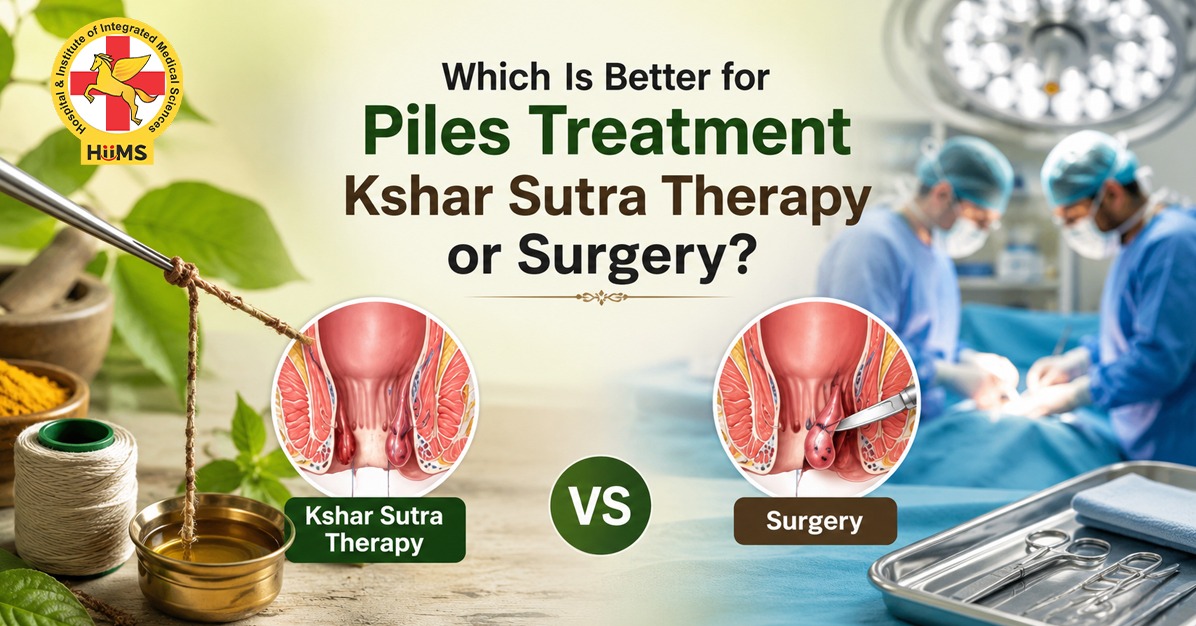
Bleeding, pain, that constant discomfort while sitting, and piles genuinely wear people down, and once medication and diet changes stop helping, the conversation usually turns to a procedure. Two options tend to come up, conventional surgery or Kshar Sutra therapy, an Ayurvedic thread-based approach that's been quietly gaining trust for good reason.
If you're comparing options for piles treatment, this blog breaks down what each actually involves, the recovery, the risks, and the genuine differences, so you're deciding with real information, not just guesswork or whatever the loudest opinion online happens to say.
What Does Surgery for Piles Actually Involve?
Surgical removal of piles, called a hemorrhoidectomy, is generally recommended for advanced or prolapsed cases, particularly when other treatments haven't worked. The procedure itself is fairly direct; the swollen veins get cut out entirely under anaesthesia. It's effective at removing the piles, but it comes with a real recovery process that's worth understanding before choosing it.
Side Effects and Recovery After Piles Surgery
This is the part that surprises a lot of people who assume surgery means a quick fix:
Significant pain for the first one to four weeks, often needing prescribed pain medication
Bleeding from the surgical site, especially during bowel movements
Difficulty urinating in the days immediately after surgery
A recovery period of two to six weeks, with heavy lifting avoided for around a month
Risk of complications like infection, anal stenosis (narrowing), or, in rare cases, changes in bowel control
About 5 in 100 people see their hemorrhoids return even after surgery
None of this means surgery is a bad option; for severe, advanced cases, it's often genuinely necessary. But for a lot of people, especially with grade 1-3 piles, it's a fairly heavy route for a problem that has gentler alternatives worth exploring first.
What is Kshar Sutra Therapy? A Gentler Route
Kshar Sutra therapy at Jeena Sikho HiiMS Meerut is a well-established Ayurvedic treatment used mainly for piles, fistula, and fissures. It uses a specially medicated thread, prepared with natural herbal ingredients, and treats the problem without needing major surgery. Not new. Not experimental. Refined and practised for generations at this point.
How Does Kshar Sutra Therapy Actually Work?
Simple, really. An experienced Ayurvedic doctor places the medicated thread at the affected site. From there, it's the herbs doing the work, slowly acting on the diseased tissue, drying it out, letting it heal, and eventually the tissue just falls away on its own. No large incision. No aggressive single-step removal. Just a gentle process that unfolds over several days.
Why is Kshar Sutra Often the Preferred Piles Treatment Today?
Goes after the actual root cause. Not just symptom control for a while, but the actual root cause. Minimally invasive too, skips the surgical trauma a hemorrhoidectomy brings, and has no long hospital stay attached to it either. Patients dealing with Kshar Sutra generally report far less post-procedure pain than surgery patients, recurrence stays low, and people get back to their normal life a lot faster.
That combination, less pain, quicker return to daily life, is exactly why this keeps coming up as the preferred answer when people ask how to treat piles without weeks of painful recovery hanging over them.
Finding the Right Piles Doctor or Piles Specialist
Not every clinic offering Kshar Sutra brings the same level of experience to it, and that genuinely matters. A skilled piles doctor should give you an honest read on your specific grade of piles, not just push whichever treatment happens to be on offer.
Look for a piles specialist who walks you through both surgical and Ayurvedic paths clearly, sets realistic expectations for recovery, and actually has consistent, hands-on experience with Kshar Sutra specifically, thread preparation and placement is a real skill, not something every clinic does equally well.
How to Treat Piles: Kshar Sutra Therapy at Jeena Sikho HiiMS Meerut?
Jeena Sikho HiiMS Meerut has experienced Ayurvedic doctors performing Kshar Sutra therapy, with the medicated thread prepared through traditional herbal formulations rather than a generic, one-size-fits-all approach. Here's what the process typically looks like for patients coming in:
A detailed assessment first, understanding your specific grade of piles before recommending anything
The medicated thread prepared fresh, using classical herbal formulations suited to your condition
Careful, precise placement of the thread by an experienced doctor, done as an outpatient procedure without a long hospital stay
Dietary and lifestyle guidance given alongside the therapy, aimed at addressing the actual cause behind the piles, not just easing symptoms temporarily
Regular follow-ups scheduled through the healing window, so your doctor can track how the treated area is progressing and adjust care if needed
The focus throughout stays on the root cause, digestion, bowel habits, and diet, rather than treating the procedure as a one-time fix disconnected from why the piles developed in the first place. This is exactly why patients tend to walk away with a genuine, lasting understanding of how to prevent recurrence, not just a treated symptom.
Conclusion
Deciding between surgery and Kshar Sutra therapy really comes down to your specific grade of piles, and honestly, how much pain and downtime you're willing to sign up for. Kshar Sutra offers a genuinely solid alternative for a lot of people, skipping the harder recovery that surgery tends to bring.
Curious which route actually fits your case? Jeena Sikho HiiMS Meerut's VOPD consultation is a good place to get a proper, honest read from their team.
FAQs
1. Is Kshar Sutra therapy painful compared to surgery?
Far less, generally. Done under local anaesthesia, with a recovery process that's noticeably gentler than a full surgical procedure.
2. How long does Kshar Sutra therapy actually take to work?
Usually, it takes a couple of days to a couple of weeks. The thread works gradually on the tissue rather than removing it all at once.
3. Can Kshar Sutra treat every grade of piles?
Works well across a wide range, but a proper assessment from a specialist tells you if it's actually the right fit for your case.
4. Does surgery mean piles definitely won't come back?
No. Roughly 5 out of 100 people see them return even after surgery so lifestyle changes still matter, no matter which route you pick.
5. Is Kshar Sutra actually a permanent fix?
It targets the root tissue directly, and recurrence tends to remain low, though maintaining good bowel habits afterwards still plays a part.