Somewhere in your daily routine, you probably look at your skin without really seeing it. That rough patch on your forearm that keeps returning, the small dark spot you noticed last month most of us make a conscious observation and move on.
The skin is the largest organ you have, and when something starts going wrong at the cellular level, it usually leaves a mark on the surface first. That is why noticing skin cancer symptoms early genuinely is important, not because every change signals something serious, but because the ones that do are far easier to address when caught on time.
In this blog, you will find a simple overview of the warning signs, the main types, what triggers them, and how the right care supports lasting skin health.
What Is Skin Cancer and Why Does It Develop?
Skin cancer starts when cells in the skin start growing in a way they are not supposed to. Healthy cells divide, do their job, and die off on schedule. When DNA damage breaks that rhythm, certain cells stop responding to the signal to stop and keep multiplying unchecked. Understanding the common skin cancer causes, such as excessive UV exposure, environmental toxins, weakened immunity, and genetic history, helps you see why that damage builds up and what you can reasonably do about it.
Common Factors That Can Raise Your Risk
Years of sun exposure without protection is one of the most consistent contributors, because UV rays chip away at skin cell DNA slowly and silently.
A family history of skin conditions creates a genetic vulnerability.
A weakened immune system, whether from illness or poor gut health, reduces the body's ability to detect and repair early cellular damage.
Environmental pollutants and synthetic chemicals in everyday products also place added strain on the skin's natural defenses.
Types of Skin Cancer You Should Know About
Not all skin cancers look the same because they start in different cells. Knowing the three main types of skin cancer helps you understand why the warning signs can vary so much from person to person.
Basal Cell Carcinoma (BCC)
The most common form. It typically shows up on sun-exposed areas like the face or neck as a shiny, pearly bump or a flat, slightly pinkish patch. It very rarely spreads to other organs but causes real local damage when left unaddressed.
Squamous Cell Carcinoma (SCC)
Affects the outer skin layers and tends to appear as a firm red nodule or a rough, crusty patch that refuses to smooth out. SCC carries a higher chance of spreading, especially in people with compromised immunity.
Melanoma
The most aggressive type. It develops in the pigment-producing cells and often shows up inside an existing mole or as a new, irregularly shaped dark growth. Because it can reach internal organs quickly, early skin cancer treatment is critical here.
Recognising Skin Cancer Symptoms: Signs That Deserve Attention
The strongest thing about skin cancer symptoms is that your skin puts them right where you can see them. Here are the signs that deserve real attention rather than just being ignored.
A growth that simply stays put—any new bump or patch that lasts more than a few weeks without healing on its own is worth showing to a doctor. Normal skin recovers from minor irritations quickly. A spot that holds its ground is a signal.
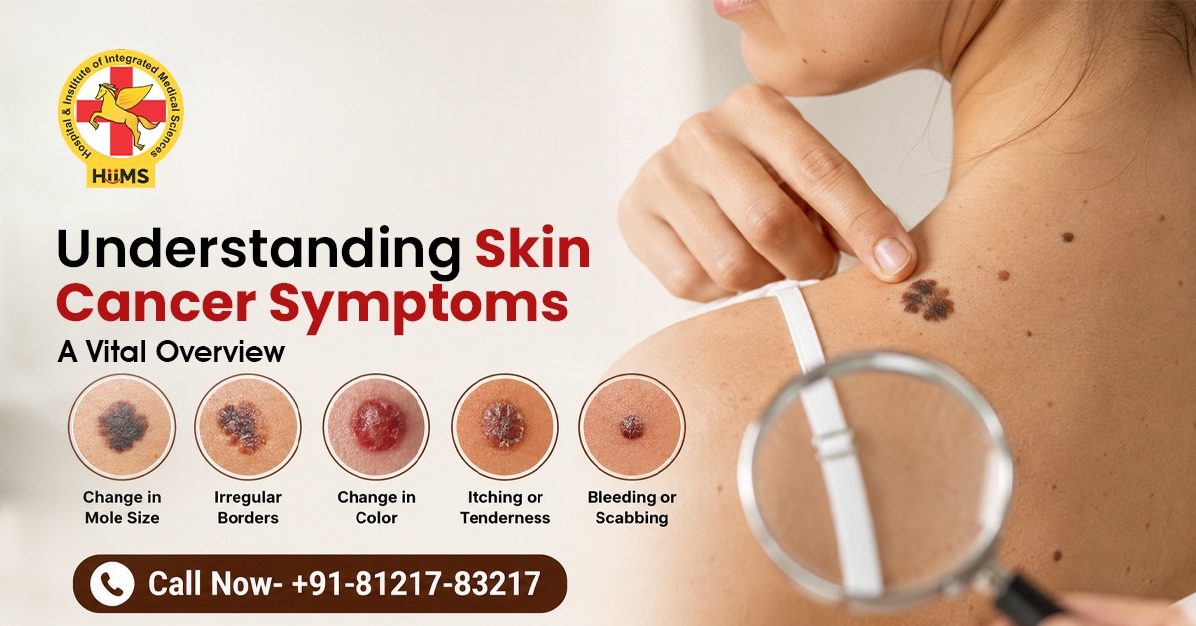
A mole that starts behaving differently—a mole that has been stable for years and then changes in shape, colour, or size is one of the clearest early warnings. Uneven edges, mismatched halves, or a mole that starts itching or bleeding without cause all need a proper check.
A wound that heals and reopens—A sore that scabs over, seems to get better, then reopens at the same spot repeatedly is a well-known early sign of BCC. People dismiss it easily, but that pattern of incomplete healing is exactly what makes it notable.
Rough, crusty patches—Patches that keep returning in the same spot and do not respond to moisturizer can point to SCC or a precancerous condition called actinic keratosis. They feel more stubborn and defined than regular dry skin.
Bleeding without obvious cause—Any spot that bleeds from minimal contact, rubbing against clothing, or drying off after a shower should not be ignored.
The ABCDE Rule for Checking Moles at Home
A – Asymmetry: One half of the mole looks clearly different from the other.
B – Border: Edges are jagged, blurred, or uneven rather than smooth and defined.
C – Color: Multiple shades, tan, dark brown, black, or red within a single mole.
D – Diameter: Larger than six millimeters, roughly a pencil eraser. Smaller ones can still be cancerous.
E – Evolving: Any change over weeks or months in shape, size, color, or texture or new symptoms like itching or bleeding. This one is the most important.
Choosing the Best Skin Care Hospital for the Right Support
When skin changes persist, finding the best skin care hospital that looks at your health as a whole, not just the visible mark, makes a real difference. The right center combines diagnostic expertise with an understanding of what is driving the problem internally.
How Jeena Sikho HiiMS Supports Holistic Skin Health
At Jeena Sikho HiiMS, the focus is on root causes rather than surface management. Skin concerns are assessed through an integrative framework that supports immunity, internal detoxification, and cellular repair alongside modern diagnostics. For individuals dealing with serious skin concerns, this whole-body approach delivers outcomes that surface-level treatment alone rarely achieves.
Conclusion
Your skin leaves signals in plain view, and skin cancer symptoms are among the clearest ones it sends. A mole that keeps changing, a sore that will not fully close, a rough patch that comes back—none of these deserve to be brushed aside. Persistent changes need professional attention, and acting early keeps your options open.
You can also opt for a VOPD online video consultation for your health concern with expert doctors at Jeena Sikho HiiMS, genuine guidance from the comfort of your home.

FAQs
1. What makes a mole suspicious enough to get checked?
Asymmetry, uneven borders, multiple colors, a diameter over six millimeters, or any change in appearance over time are all reasons to visit a dermatologist.
2. Does skin cancer only appear on sun-exposed areas?
Skin cancer can develop anywhere, including under fingernails, on the soles of the feet, and between the toes areas that rarely see sunlight.
3. From what age should regular skin checks begin?
Starting from early adulthood makes sense, particularly for those with fair skin, a family history of skin conditions, or significant past sun exposure.
4. What is actinic keratosis and should it be treated?
A rough, scaly precancerous patch caused by long-term UV damage, it does not always turn cancerous but carries that risk if left unmonitored and untreated.
5. How does integrative skin care differ from standard treatment?
Integrative care, such as at Jeena Sikho HiiMS, addresses root causes like immunity, nutrition, and toxin load alongside the visible skin concern, supporting the body's own healing rather than only treating the surface.