Piles are swollen blood vessels in and around the anus. They are common, and they often begin without much pain. Because of this, many people ignore the early signs until the problem becomes harder to manage.
A clinical study of 189 adults aged 35 to 65 found that 36.5% had Grade IV piles when they were examined. Constipation was the most common risk factor, seen in 30.1% of the patients.
This blog explains the four stages of piles, their causes, daily habits and the care options available. As a result, you can see where each stage stands and what to do next.
What Are Piles? Understanding Swollen Veins in and Around the Anus
Piles, also called haemorrhoids, are soft cushions of blood vessels that help control bowel movements. They become a problem when they swell. Internal piles form inside the rectum, so they are usually painless. External piles form under the skin around the anus, so they cause more pain and itching.
Common signs include bleeding during a bowel movement, itching, swelling, and a lump near the anus. Early attention helps with piles management, because each stage responds better to timely changes. Doctors classify piles into four grades.
Noticing bleeding or discomfort and unsure what it means? Talk to our experts.

What Are the Different Stages of Piles?
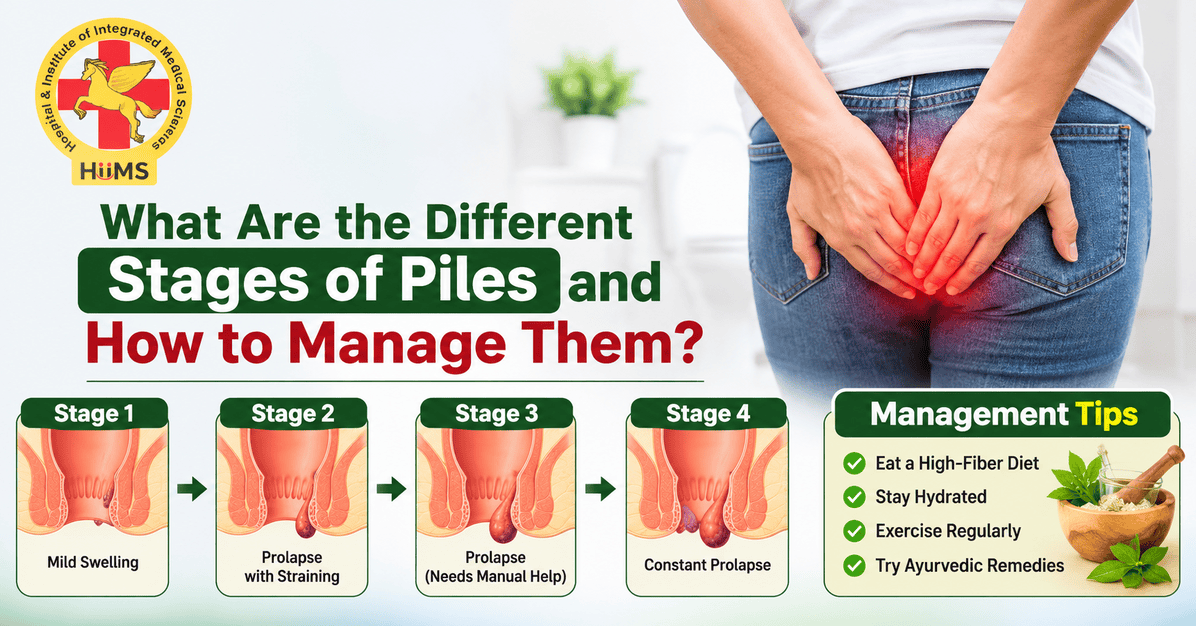
Doctors grade piles by how far they slip out of the anus. Each stage has different signs, so it helps to know them.
Stage 1 (Grade I)
The swollen veins stay inside the rectum, so nothing can be seen or felt from outside. The main sign is painless, bright red blood on the stool or tissue. Many people ignore these symptoms because there is no pain. However, simple changes in diet and routine often make the most difference at this stage. Because the veins are still small, early care is usually the easiest.
Stage 2 (Grade II)
The piles slip out during a bowel movement and then go back in on their own. Bleeding may continue, and a mild feeling of fullness or itching is common. Because the piles still return by themselves, many people delay a check-up. This stage is a good time to correct habits before the problem grows. For example, adding fibre and avoiding long toilet sits can help a great deal.
Stage 3 (Grade III)
The piles slip out and do not go back unless you push them in with a finger. Discomfort, mucus and itching become more frequent. In addition, sitting for long hours can feel uncomfortable. At this stage, a doctor's guidance becomes more important. The piles can swell further if constipation and straining continue.
Stage 4 (Grade IV)
The piles stay outside and cannot be pushed back. Pain, swelling and blood clots are more likely, and daily activities can become difficult. Therefore, this stage needs prompt attention from a qualified doctor. Sudden severe pain or a hard, swollen lump should not be left for later.
Did you know? In the study of 189 patients, 26.9% had Grade I piles, 16.4% had Grade II, 20.1% had Grade III, and 36.5% had Grade IV. This suggests that many people seek care only at a later stage.
Stages are easier to prevent than to reverse, so the next section looks at what causes piles to develop.

Why Do Piles Develop? Common Causes and Risk Factors
Piles form when the veins around the anus are under constant pressure. In the same study, these factors were the most common:
Constipation: Hard stools need more effort to pass. This was the leading factor, seen in 30.1% of patients.
Sedentary habits: Long hours of sitting slow digestion and add pressure on the lower rectum. This was seen in 20.6%.
Straining: Pushing hard during a bowel movement swells the veins. This was seen in 17.4%.
Alcohol, chronic cough, and smoking: These were seen in 12.6%, 10%, and 9% of patients, respectively.
Most of these causes are part of daily routines, which is where piles management begins.
Some Daily Habits for Piles Management
Small habits, followed every day, help the bowels work smoothly. They also lower the pressure on the veins.
Eat more fibre: Vegetables, fruits, whole grains and pulses add bulk to the stool, so it passes easily.
Drink enough water: Water keeps the stool soft. Sip it through the day instead of drinking a lot at once.
Keep a fixed toilet time: A regular routine trains the bowels. Go when you feel the urge, and do not hold it back.
Avoid straining and long toilet sits: Spend only a few minutes on the toilet and leave if the stool does not pass.
Move through the day: A short walk every hour or two helps digestion. A daily walk also reduces constipation.
Want a daily routine that fits your work hours? Speak with our team.

When to See a Piles Specialist?
Mild symptoms may settle with better habits. However, some signs need a proper check-up. See a piles doctor if bleeding continues for more than a few days, if the piles stay outside or if the pain is severe. Bleeding with weight loss or a change in bowel habits also needs evaluation, because other conditions can cause similar signs. A piles specialist can confirm the stage, so you can choose the right care with confidence.
Conventional Treatment Options for Piles Treatment
Conventional piles treatment depends on the stage. Early stages are usually managed with diet changes, stool softeners and creams. For later stages doctors may suggest procedures such as rubber band ligation or surgery.
These options work for many people. However, procedures can involve recovery time and some post-procedure discomfort and piles can return if daily habits stay the same. This is why many people also look at the root of the problem, such as digestion and bowel habits.
How Ayurveda Looks at Piles: Arsha and Their Management
In Ayurveda, piles are called Arsha. Classical texts link them to weak digestive fire (Agni), constipation (Vibandha) and the build-up of undigested waste (Ama). According to this view, care begins with digestion and bowel regularity.
The classical texts also describe stage-wise measures. These include herbal medicines (Bheshaja), alkaline applications (Kshara), heat-based methods (Agni karma), and surgical methods (Shastra karma). As a result, Ayurveda offers options for both early and later stages. In addition, it asks about food, sleep, and stress, because these shape digestion every day.
Understanding this approach explains how an integrated hospital can plan care for piles.
Piles Management at Jeena Sikho HiiMS Meerut
Jeena Sikho HiiMS is an integrated hospital that combines Ayurveda, Naturopathy, Homeopathy, Unani, and modern science. For piles, this means your stage, digestion, and daily routine are looked at together. If you wonder how to manage piles, the HiiMS approach includes the following.
Kshar Sutra Therapy
Kshar Sutra is a classical Ayurvedic para-surgical therapy. A medicated thread coated with herbal preparations is tied around the base of the pile mass. The thread is changed at intervals, and the pile mass gradually shrinks and separates. It is traditionally used for later stages and avoids a surgical cut. The doctor checks the stage first and then plans the number of sittings and follow-up visits.
Panchkarma
Panchkarma is a set of cleansing therapies. For piles, therapies such as Basti (a medicated enema) are traditionally used to support bowel regularity and ease the digestive system. Before any therapy, the doctor reviews your digestion, strength, and medical history, so the plan stays personal.

Herbal Support
Traditionally used herbs such as Triphala, Haritaki, and Kutaj are chosen to support digestion and soft, regular stools. The doctor selects them according to your stage and body type. These herbs are usually taken along with diet changes, so the whole plan works together.
pH-Balanced Diet
A pH-balanced diet focuses on fibre-rich, easily digestible foods. It also avoids spicy, fried and processed items that can irritate the bowels. Meals are planned across breakfast, lunch and dinner so that fibre and fluids stay steady throughout the day.
Mind & Body Healing
Stress affects digestion so this approach combines yoga, breathing practices, and lifestyle guidance. Together, they support a calmer routine and healthier bowel habits.
Conclusion
Piles are common, and they are easier to manage when noticed early. Bleeding, itching or a small lump is worth a check-up, even when it causes no pain. Small daily habits, such as eating enough fibre and drinking enough water, also help keep the problem from growing. Ayurveda follows the same idea by looking at digestion and routine along with the symptoms.
Speak with the Jeena Sikho HiiMS Meerut team about piles management through VOPD (video consultation). Get personalised guidance with a piles specialist from home.

FAQs
1. What are the four stages of piles?
Grade I piles stay inside. Grade II slip out and go back on their own. Grade III needs to be pushed back and Grade IV stays outside.
2. Can piles go away on their own?
Early piles may settle with a better diet and habits. If bleeding or swelling continues, consult a doctor.
3. Which stage of piles needs a doctor?
Any bleeding that lasts more than a few days needs check-up. Grades III and IV need prompt attention.
4. Do diet changes help piles?
Yes. Fibre-rich food and enough water keep stools soft which lowers strain on the veins.
5. What does Jeena Sikho HiiMS Meerut offer for piles?
It follows an integrated approach that includes Kshar Sutra Therapy, Panchkarma, herbal support, a pH-balanced diet and Mind & Body Healing.
Disclaimer: The information shared in this blog is for general educational and informational purposes only. It should not be considered a substitute for professional medical advice, diagnosis, or treatment. Please consult a qualified healthcare professional for advice based on your individual health needs. Do not make changes to your diet, lifestyle, or treatment plan without proper guidance.
Author: Kishan Kant Soni

Dr. Kishan Kant Soni has experience in Ayurveda of around 2 years. He is one of the best Ayurvedic Doctors in Meerut. His areas of expertise include the management of diabetes, Cancer, Liver diseases, Back pain, Kidney diseases, Heart disease and Skin disorder etc. Many individuals have benefited from her ayurvedic treatment.